Thomas Finn wrote a lengthy booklet entitled ‘Cloontia and its People and its Past’ that I have used to aid my research and it is mentioned in other blog pages. In it he mentions the famous ‘Darkie’ Finn.
Tom also wrote a very short paper ‘My Cousin The Darkie Finn’. Darkie earned his nickname from his sallow skin and jet black hair. His real name was Patrick Finn and he is also a distant relation of mine and many others, as well as Thomas Finn. He came from a hamlet of five houses in County Mayo called Sheskeen, which is very close to my various family connections in Cloontia, County Mayo, Ireland. Because times were hard, it became the norm for men in the area to travel to England for work. Darkie returned home and persuaded his cousin Tom to travel to England with him, promising he would get a job for both of them. Tom was just short of his eighteenth birthday and they left together on Easter Saturday in March 1937. It must have been tough to leave home at such a young age. Only Darkie’s presence and assurances of a job would have persuaded Tom to travel. Thomas’s grandmother Nancy Finn was the sister of Darkie’s grandmother Catherine Finn McGeever and so they were second cousins.
Tom got work on a farm near Chester and Darkie moved elsewhere for building work. They met again two years later and were working together on a Ministry of Defence building near Buxton in Derbyshire, when the Second World War broke out. Tom returned to Ireland at Christmas 1939 to avoid being called up to the British Army. Darkie, who was some ten years older, was not due for call up, so he carried on with this building work. He survived the war but never did return to Ireland. There is a family gravestone in Carracastle cemetery that just states ‘Patrick Finn (Darkie) – died England’. Sadly, Tom never met him again, but occasionally he did hear of his exploits. Darkie spent his final years with his sister Maggie in East Linn, Norfolk.
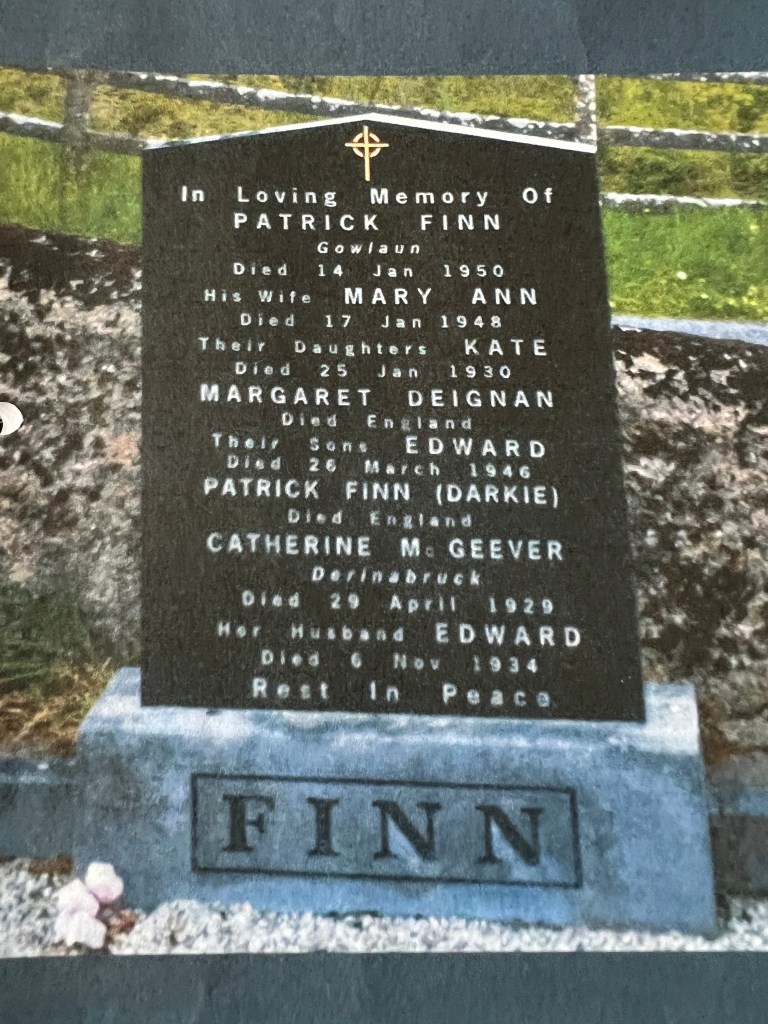
Darkie’s parents Patrick Finn and Mary Ann McGeever are at the top of this gravestone. Next is his sister Margaret Finn, the aforementioned Maggie, followed by his brother Edward Finn, then Darkie himself. The last two names are Catherine and Edward, Mary Ann’s parents and grandparents of Maggie, Edward and Darkie. This is an unusual order on a gravestone, particularly as two of those recorded are not in the grave. It took me a while to puzzle out, because I had this photo quite a while before the rest of the research was completed. In the 1911 census Patrick and Mary Ann had been married 12 years and they had five children, all of whom were living. I have been able to identify sister, Kate Finn, who died on 25th January 1930, who does not appear on this gravestone, plus there was another unidentified sibling.
A neighbour called Martin Henry in nearby Rooskey, Count Mayo, wrote a song about Darkie’s exploits. Later Dominick Behan of The Dubliners took many of Martin’s lines and produced the famous song ‘McAlpine’s Fusiliers’. The song mentions Darkie Finn, son of Pat from Sheskeen. The song was about the many Irish labourers (navvies) who left home to work on large scale building projects, including working for McAlpines, Wimpey, John Laing and other large construction companies. It can be found in various recordings on YouTube.
The following chart shows the family connection from the sisters Catherine and Nancy through to the second cousins Darkie and Thomas:

I have two DNA Connections through Catherine Finn’s descendants and four DNA connections through Nancy Finn’s descendants. These are all weak connections at the limit of where a positive result will be achieved. I am aware of many other siblings of those with positive DNA tests, where the DNA results are below the threshold for a positive result, but I am almost certain that they are also distant relatives. It is unusual to be associated with the lyrics in a song and so Darkie Finn lives on through McAlpine’s Fusiliers.
 My Family Connections